by John Collier
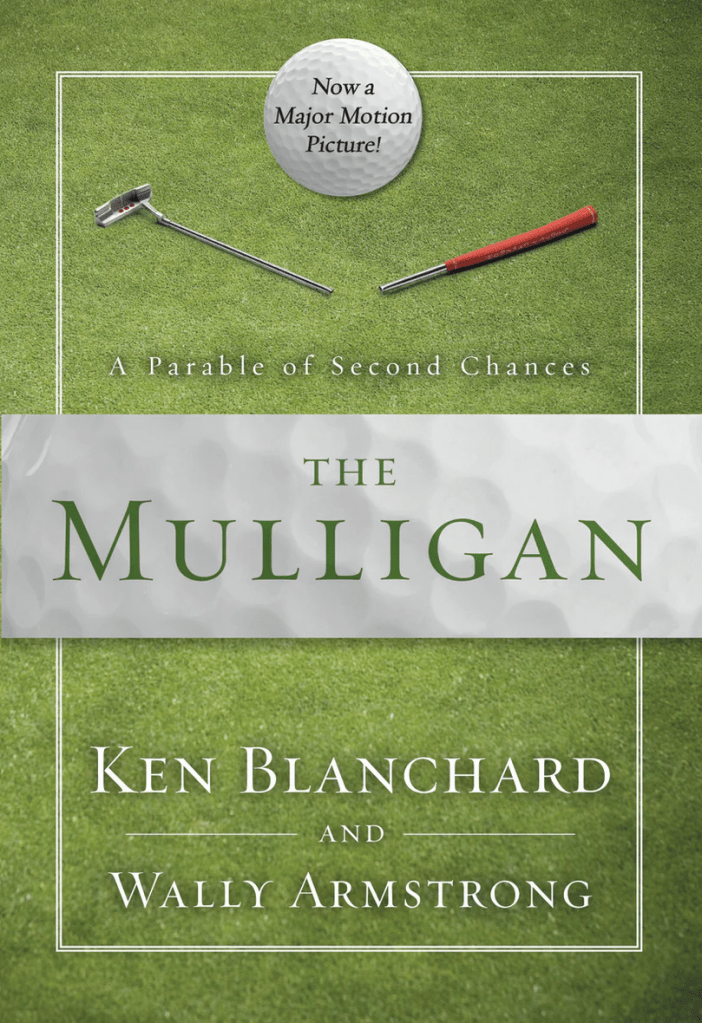
Blanchard, Ken and Wally Armstrong. The Mulligan: A Parable of Second Chances. Grand Rapids, Michigan: Zondervan, 2010.
Review:
I don’t read much fiction. Other than the occasional John Grisham novel, I just don’t enjoy it. But The Mulligan is a short little book clocking in at around 150 pages. And I like golf. I don’t get to play anymore due to an injury, and I miss it. So a short story that revolved around golf and changed lives sounded like something I could get behind. Let me be clear. If you are looking for great literature, this isn’t your book. It is written simply. The Mulligan isn’t just a simply written little story; it is a parable. It says so right in the title. By their nature, parables are meant to be simple stories that make a point. And this parable certainly does that.
The Mulligan tells the story of Paul McAllister, a business executive in Atlanta, Georgia, who thinks he loves to play golf. At a Pro-Am tournament in Ashville, North Carolina, he embarrasses himself in front of Davis Love, III, the professional in his group. Davis has the insight to recognize Paul’s problem is deeper than his game and suggests he meet with an old man named Willie Dunn, know by most simply as the Old Pro.
In this parable, the Old Pro has an almost supernatural insight and wisdom. He knows exactly what comments to make and questions to ask Paul and elicits perfectly and completely honest responses. If you are reading this as fictional literature, it is too easy; as a parable, it makes perfect sense. As the story progresses, the comments and questions lead Paul to dig deeper into his past and current relationships, including with his estranged son.
Like most parables, there is not much in the way of suspense. You can see virtually every turn in the story coming from far away. You may consider these spoilers, but as you read the book, they will not take you by surprise. Paul begins the story as an angry, bitter man who is hungry for wealth and power in business and has no interest in anything spiritual, much less a relationship with God. Over the course of his time with the Old Pro, he comes to follow Christ as Savior and Lord. The relationship between Paul and his son is restored. And there is a beautiful moment when, after the death of the Old Pro, a young man at the memorial service meets Paul and asks him to teach him.
Reflect:
I have come to be more and more convicted that we have grossly misunderstood the Great Commission as given in Matthew 28:18-20.
18 Jesus came near and said to them, “All authority has been given to me in heaven and on earth. 19 Go, therefore, and make disciples of all nations, baptizing them in the name of the Father and of the Son and of the Holy Spirit, 20 teaching them to observe everything I have commanded you. And remember, I am with you always, to the end of the age.” (CSB)
Please let me be clear on this: I whole-heartedly believe that evangelism and “soul-winning” are part of our duties as followers of Christ. We are meant to see people converted to Christ. But notice that in the Great Commission, Jesus does not explicitly tell us to do those things; he does explicitly tell us to make disciples. I have come to the conviction that if we focus on discipling individuals in the Gospel, we will see people converted and souls won. The Mulligan is a good illustration of that truth.
As Paul begins to meet regularly with the Old Pro, he has not yet committed to following Christ. But the Old Pro continues to teach him Gospel truths that apply to all of life, including the specific issues Paul is currently facing. As the Old Pro does this, he is inviting Paul into a relationship with Christ. He is sharing the Gospel. And in time, Paul surrenders to the lordship of Christ. The Old Pro disciples Paul to conversion. It is a beautiful picture.
Because The Mulligan is a parable, it is an oversimplified lesson in the discipleship relationship. But that does not decrease its truth or effectiveness. It is not meant to be a discipleship “how-to” manual; it is meant to be a picture of a life changed through the discipleship journey.
Recommend:
I want to recommend The Mulligan with some reservations. This recommendation applies to virtually anyone. For the pastor or church leader, it is a great reminder of the call to enter into discipleship relationship with others, as well as a potential model for how to do so. For the “average” Christian, it can deepen one’s faith and provide encouragement as well as a strategy for discipleship. For the unbeliever or spiritual seeker, it can provide the answers for which they are searching and perhaps be used to provide the courage and conviction necessary to seek out a more mature Christian to walk this journey with them.
Now for the reservations. As I was reading The Mulligan, I began to notice language about visualization and mentally focusing on the positive. Initially, I assumed this was simply the talk of sports psychology. One of the authors, Wally Armstrong, is a former touring professional golfer and at the age of 80, still works as a public speaker and golf skills coach. I am one of those odd readers who reads the entire book, including the forward, introduction, about the author, and even the acknowledgments. And it was the acknowledgments that filled in some blanks. One of the individuals Wally Armstrong thanked was Dr. David Cook, who is a well-regarded sports psychologist. Dr. Cook is also the author of Seven Days In Utopia: Golf’s Sacred Journey, which was later made into a movie starring Robert Duvall and Lucas Black. (I recommend both the book and movie.)
But then I read the acknowledgments from Ken Blanchard. Blanchard is an expert in management and leadership. He has published more than 70 books and teaches at the University of San Diego in California. His acknowledgments included Henry Blackaby (author of Experiencing God), which was encouraging. They also included Norman Vincent Peale and Tony Robbins, which is clearly where the visualization and positive thinking influence came from.
There is nothing in The Mulligan that I disagree with outright, but it was definitely influenced by the world of motivational speakers and self-help pop psychology. Read it with a little caution. It is a parable, not a playbook or a manual. It can and should be inspirational when it comes to being discipled or making disciples. It is a good book, easy to read and apply, and should be a great encouragement.
 texaschallenge.net