by John Collier
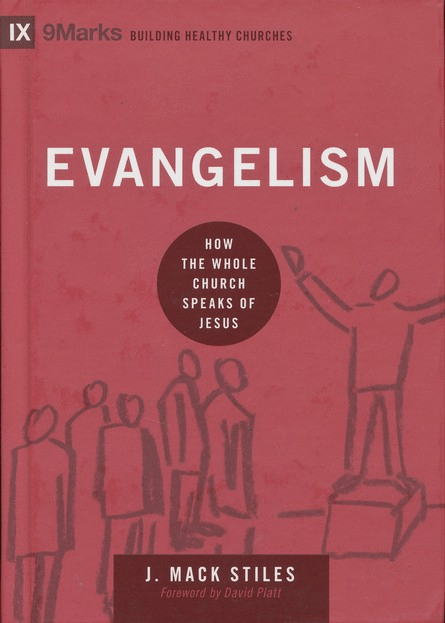
Stiles, J. Mack. Evangelism: How the Whole Church Speaks of Jesus. Wheaton, Illinois: Crossway, 2014.
Review:
I have become a fan of books that are short, to the point, and easy to read. It’s not that I can’t read more complicated works; I certainly can and do. These books I have become a fan of tend to be highly practical, and I try to be a practitioner. Evangelism by J. Mack Stiles is this kind of book. Coming in at around 125 pages, including indices, this book gets to the point in a hurry. What is that point? It is to help us understand what evangelism is and to challenge us to actually do the work of evangelism as the local church. I think those are the two things about evangelism we so often miss: actually doing the work and the importance of the local church in the practice of evangelism. And those are the two main areas of focus for Stiles.
First, he wants us to understand what evangelism is. Here is his simple definition: “Evangelism is teaching the gospel with the aim to persuade.” (page 26) That’s it. It does not require an altar call. It does not require that the person being evangelized make a commitment in order for evangelism to have taken place. It simply requires that we “teach the gospel with the aim to persuade.” Stiles goes on to amplify his definition (in the style and tradition of the Amplified Bible): “Evangelism is teaching (heralding, proclaiming, preaching) the gospel (the message from God that leads us to salvation) with the aim (hope, desire, goal) to persuade (convince, convert).” (page 27)
Having provided a better understanding of what evangelism is, Stiles goes on to connect the call to evangelism and the local church. This starts with the understanding that the New Testament seems to know nothing of Christians who are not part of a local church. This means that the call to evangelism is not just a call to individual Christians, but a call to the church, since they cannot and must not be separated. We all want our local churches to be healthy representations of Christ’s kingdom on earth. A culture of evangelism is required if a local church is to be healthy.
Stiles goes on to provide practical instruction for evangelism in and through the local church. He does not advocate for a particular evangelism strategy such as the “Romans Road” or D. James Kennedy’s Evangelism Explosion. Instead, he offers practical, biblical principles for sharing our faith. These are principles that help us keep ourselves and our role in evangelism in perspective, leaving the results to the work of the Holy Spirit.
Reflect:
I have been a Christian almost all my life. I have been active and involved in the local church almost as long as that. For most of my life I have been taught and have had some understanding of the value the Bible places on evangelism and The Great Commission. But even with that background, I have not often effectively practiced evangelism. I believe in it. I understand it. I know Christians are commanded to do it. While all of that is true, I have had a terrible habit of not doing evangelism.
There are probably a lot of reasons this is the case. But that doesn’t excuse my disobedience. I think one of the problems is that I felt a responsibility to “close the deal.” Cognitively, logically, I understood that conversion is not my responsibility, yet I still felt that if the person did not make a commitment then and there to follow Christ, somehow I had failed at evangelism. I think I also saw evangelism as a solo sport. It was just me, and a host of other individual Christians working independently of each other, against all the forces of darkness. Nothing could be further from the truth. I don’t want to absolve any individual Christian from their responsibility to be an evangelist, but it is not their responsibility alone. It is their responsibility as a part of the local church. We are in this together.
Recommend:
Evangelism: How the Whole Church Speaks of Jesus is part of the “Building Healthy Churches” series of books developed by 9Marks and published by Crossway. This is a great little book, as have been all of the series I have thus far read. Some of the titles would be most beneficial specifically for pastors and church leaders. Other titles in the series, such as this one, would be valuable for any church member to read and take to heart.
 texaschallenge.net